
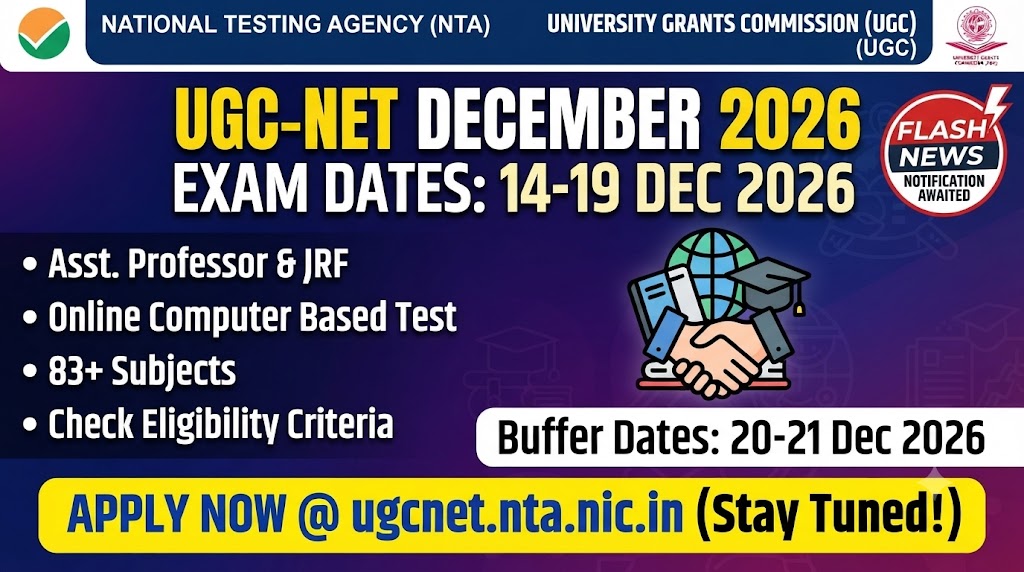
UGC NET December 2026 (University Grants Commission – National Eligibility Test)
Civil Services

UGC NET December 2026 (University Grants Commission – National Eligibility Test)

Exam Overview

Conducting Authority: National Testing Agency (NTA) on behalf of the University Grants Commission (UGC). Scope & Prestige: Conducted twice a year, UGC-NET determines the eligibility of Indian nationals for Junior Research Fellowship (JRF), appointment as Assistant Professor, and admission to Ph.D. programs in Indian universities and colleges. It covers over 80+ diverse subjects in a Computer-Based Online Test format.

Age & Educational Eligibility

Eligibility Requirements (Age, Degrees & Attempts): Educational Qualification: Master’s Degree or equivalent from a recognized university with at least 55% aggregate marks (50% for OBC-NCL, SC, ST, PwD, and Third Gender candidates). Final-year postgraduate students may apply provisionally. Age Limit: Junior Research Fellowship (JRF): Maximum 30 years (relaxable as per Govt. rules). Assistant Professor & Ph.D. Admission: There is no upper age limit.

Selection & Written Exam Pattern

Mode of Exam: Online Computer-Based Test (CBT). Duration: 3 hours (180 minutes) composite time for both papers without any break. Structure: Paper I: 50 multiple-choice questions (100 Marks) — Common for all candidates, focusing on teaching/research aptitude, reasoning, comprehension, and general awareness. Paper II: 100 multiple-choice questions (200 Marks) — Subject-specific questions based on the candidate's chosen postgraduate discipline. Marking Scheme: +2 marks for every correct response. Negative Marking: No negative marking for incorrect or unattempted answers.

Subject-Wise Syllabus Structure

Detailed Syllabus Breakdown by Subject & Paper: Paper I Syllabus (Common Core Units): Teaching Aptitude, Research Aptitude, Reading Comprehension, Communication, Mathematical Reasoning & Aptitude, Logical Reasoning, Data Interpretation, Information & Communication Technology (ICT), People, Development & Environment, and Higher Education System (Governance, Polity & Administration). Paper II Syllabus: In-depth core domain knowledge spanning across 80+ specific subjects (such as Commerce, History, Political Science, English, Management, Computer Science, Economics, etc.) corresponding to postgraduate Master's curricula.

Expert Preparation & Study Strategy

1. Master Paper I thoroughly using standard reference guides for teaching and research aptitude alongside practicing regular data interpretation and logical reasoning puzzles. 2. Dedicate focused daily study hours to Paper II (worth 66% of total marks) to ensure deep domain mastery. 3. Solve past 5 years' Previous Year Questions (PYQs) and full-length online mock tests under timed 3-hour conditions.

Frequently Asked Questions

Q.Q: Is there negative marking in UGC NET?

A: No, there is no negative marking for incorrect answers.

Q.Q: Can final-year Master's students apply?

A: Yes, candidates awaiting their final-year results are eligible to apply provisionally.

Q.Q: What is the official website to apply?

A: Applications will be hosted online at ugcnet.nta.ac.in.

Share with friends & aspirants:
Official Channels:

Discussion & Queries0

Be respectful and keep questions relevant to the examination.
No comments yet. Be the first to start the discussion!
Official Community@jobandexam

Get Instant Alerts on Telegram & WhatsApp

Be the first to download Admit Cards, official answer keys, cut-off marks, and Sarkari notifications before servers get busy.

100% Free•No Spam•Direct PDF Links

Important Timelines

Official NExam Cycle Timeline & Key Events: Notification Release: October 2026 (Expected) Online Application Start Date: October 2026 (Expected) Last Date to Apply Online: Late October 2026 (Expected) Application Correction Window: November 2026 (Expected) Admit Card Release: December 2026 UGC NET Examination Dates: 14 to 19 December 2026 Buffer Dates: 20 to 21 December 2026otification